Overview
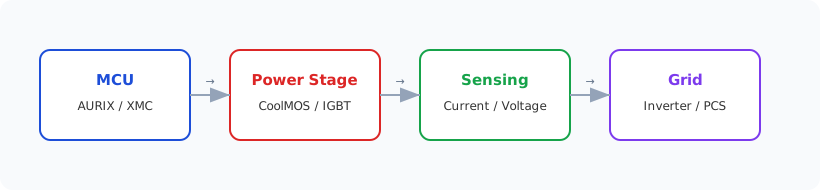
Renewable energy is now the cheapest source of new electricity in most markets, and its growth depends on power electronics that convert variable solar and wind energy into stable grid power. Solar inverters, battery storage systems and hybrid converters all demand efficiency, reliability and safety. BeiLuo's renewable solution combines Infineon's 1200 V IGBT technology, CoolMOS super-junction MOSFETs and AURIX safety-capable control into architectures that maximize energy harvest and meet grid codes worldwide.
Solar Inverter Architecture
A string solar inverter begins with the DC-DC boost stage, which implements maximum power point tracking on each string, followed by a DC-AC inverter stage that feeds the grid. In a three-phase 20 kW design, six IKW40N120H3 IGBTs form the grid-tie bridge. Their 1200 V rating provides headroom for the high DC bus voltage of modern strings, and the 175 °C junction temperature rating supports the outdoor operating conditions of rooftop installations.
MPPT Control
Maximum power point tracking squeezes the last watt from every panel. The IPP60R099P6 boost stage switches at high frequency, and the digital MPPT algorithm runs on the AURIX TC277, adjusting duty cycle to track the panel operating point under partial shading and cloud movement. Fast tracking means more energy harvested per day, which directly improves the financial return of the installation.
Grid Compliance
Grid-tie inverters must satisfy strict grid codes covering harmonics, anti-islanding and fault ride-through. The AURIX platform executes the grid monitoring algorithms while its safety features support the fail-safe disconnection that regulators require. TLE4972 sensors measure grid currents with the precision needed for low-harmonic output, and the analog outputs feed the AURIX ADCs for control and protection simultaneously.
Battery Energy Storage
Storage systems make renewable energy dispatchable. The bidirectional power conversion system charges the battery from solar surplus and discharges it during peak prices. TLE4972 current sensors measure both directions, supporting the state-of-charge estimation and protection that keep lithium batteries safe. The AURIX safety architecture extends to the storage system, monitoring voltages, currents and temperatures and triggering disconnect in fault conditions.
Reliability in the Field
Inverters sit on rooftops and in fields for 25 years. Component reliability is therefore paramount: the IGBT modules are rated for millions of power cycles, the CoolMOS devices for stable avalanche energy, and every part in the BeiLuo supply chain is genuine and traceable. Import declarations and certificates of origin support the customs compliance of inverters shipped across borders, and RoHS certificates satisfy environmental regulations in every market.
System Efficiency
Every percentage point of efficiency matters in renewable energy. The combination of low-loss IGBTs, super-junction MOSFETs and digital control pushes peak inverter efficiency above 98 percent, and the wide efficiency curve keeps losses low even at partial load, where most systems operate most of the time. Lower losses also mean smaller heatsinks, lighter enclosures and lower shipping cost. Efficiency verification is part of our FAE support: we can help you set up efficiency measurement points, interpret the results against datasheet curves and optimize the control parameters to recover the last tenths of a percent. Long-term degradation is also predictable, because the temperature cycling capability of the IGBT and MOSFET devices is documented and can be modelled against your inverter's thermal profile.
Wind and Microgrid Applications
The same power electronics serve small wind turbines and community microgrids. Wind converters rectify variable-frequency generator output to a DC bus, then invert to grid AC at the required frequency and phase. The 1200 V IGBT stage and AURIX control platform handle the wider voltage and frequency variations of wind power, and the TLE4972 sensors measure generator currents for maximum power tracking under fluctuating wind. Microgrid controllers use the same hardware to manage islanded operation, switching seamlessly between grid-connected and standalone modes.
Monitoring and Fleet Analytics
Inverters deployed in the field generate valuable operational data: energy yield, temperature, DC link ripple and fault events. The AURIX controller logs these parameters and reports them over the monitoring interface, and fleet-level analytics identify underperforming installations before customers notice. Our FAE team supports the development of these monitoring features and helps you select the storage and communication options that match your service model.
Hybrid Systems and Energy Management
Hybrid systems couple solar, storage and grid, and the energy management controller decides when to use each source. The AURIX platform runs the optimization algorithm, considering tariff schedules, forecast production and battery state, and commands the converters accordingly. Peak shaving shifts load from expensive grid periods to stored solar energy, and the TLE4972 sensors provide the accurate power metering the optimization depends on. As energy markets liberalize, the same hardware can participate in demand response programs, creating new revenue streams for the installation owner.
Getting Started
Our FAE team supports inverter topology selection, gate drive design and grid-code testing. Request the evaluation BOM for your string inverter or storage system, and let us confirm stock, allocation and volume pricing for your production forecast.